New Mathematical Methods in Geometry ProcessingHSM Special Topic School

Europe/Berlin
Endenicher Allee 60/1-016 - Lipschitzsaal (Mathezentrum)

Endenicher Allee 60/1-016 - Lipschitzsaal

Mathezentrum

Endenicher Allee 60 53115 Bonn
90
Martin Rumpf, Pavel Barikin (Hausdorff Center for Mathematics)
Description

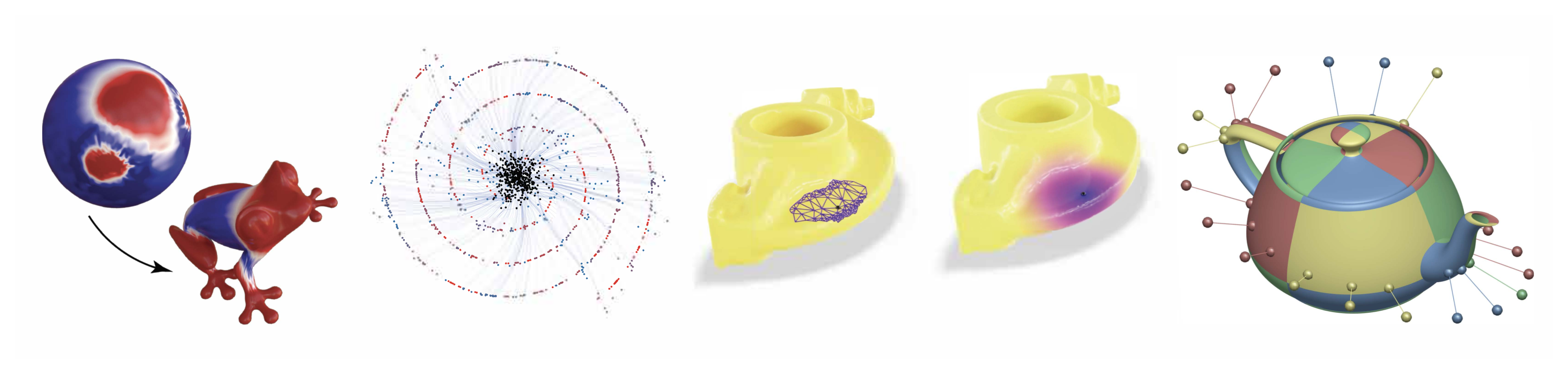
Geometry processing - the acquisition, reconstruction, and manipulation of geometry - is a vibrant research area with novel mathematical models and an increasing impact of machine learning tools. The challenges in these developments include the sheer size of data sets due to advancing acquisition technologies, robustness in the presence of noise and damaged data, the arbitrary topology of surface meshes, as well as the development of structure-preserving discrete algorithms.

Lecture series by:

  • Justin Solomon (Massachusetts Institute of Technology)
    • Convex Models for Machine Learning, Graphics, and Geometry Processing
  • Gabriele Steidl (TU Berlin)
    • Flows in Measure Spaces and Generative Modelling
  • Niloy Mitra (University College London)
    • Neural Surfaces: Analyzing Geometric Surfaces Encoded as Neural Networks
  • Emery Pierson (École Polytechnique)
    • Neural Network Architectures on non-Euclidean Spaces


The special topics school will combine 4 times 3 lectures delivered by the lecturers, interactive practical sessions, and ample time for discussions and exchange between participants. It will foster interaction at the interface between mathematical analysis, numerics, vision and graphics.

The deadline for the application for participation is January 11th, 2026.

Our Global Mobility Fellowships provide participation opportunities for selected researchers and PhD students from countries of the Global South in the Special Topic Schools of the Hausdorff School for Mathematics. For more information, please visit our website.
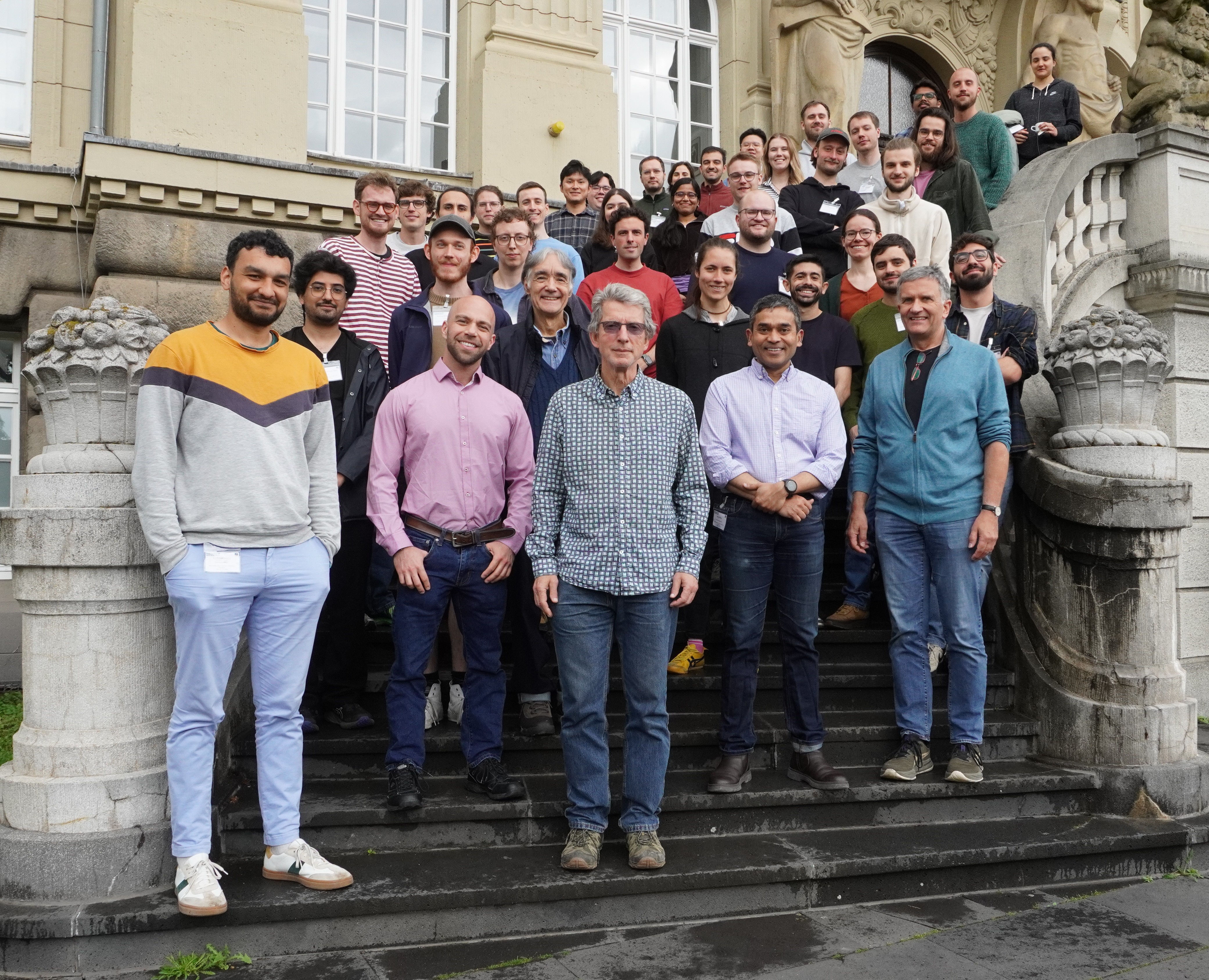
Scientific Organizers:

    • Martin Rumpf (University of Bonn)
    • Peter Schröder (University of Bonn, California Institute of Technology)
    • 8:15 AM 9:00 AM
      Self-Registration 45m
    • 9:15 AM 10:15 AM
      Neural Explicit Representations 1h

      We start by exploring how neural networks can explicitly parametrize surfaces while handling surfaces with different genus mapping 2D domains to complex 3D shapes. We will review how these overfitted representations provide direct access to the first and second funda¬mental forms, ultimately enabling the construction of a continuous Laplace neural/shape operator.

      Speaker: Prof. Niloy Mitra (University College London)
    • 10:15 AM 10:45 AM
      Break 30m
    • 10:45 AM 11:45 AM
      Introduction to Geometric Deep Learning for Surfaces 1h

      The course will be divided in two parts: introduction to surface representations (point cloud, meshes) and discretizations of simple quantities. The second part will introduce deep learn-ing (MLP, CNNs, transformers) and the challenges associated to geometric deep learning on surfaces. It is possible that the course will finish during the second lecture.

      Speaker: Mr Emery Pierson (Ecole Polytechnique)
    • 12:00 PM 1:30 PM
      Lunch Break 1h 30m
    • 1:30 PM 2:30 PM
      Fast Forward Session 1h
    • 2:30 PM 3:00 PM
      Break 30m
    • 3:00 PM 4:00 PM
      Fast Forward Session 1h
    • 9:00 AM 10:00 AM
      Recognizing Convex Structure in Geometry Problems 1h

      We motivate our discussion by developing intuition for the space of convex optimization problems, motivated by function smoothing, shortest path computation, and other problems in geometry. We will see that a rich class of problems can be understood through the lens of convex optimization; moreover, even when a problem is not obviously convex, a series of strategies can be used to derive a convex relaxation whose solution may approximate the solution to or even solve the original problem.

      Speaker: Prof. Justin Solomon (MIT)
    • 10:15 AM 11:15 AM
      Neural Implicit Representations 1h

      We shift focus to implicit neural fields and their roots in classical geometry, highlighting why they are so popular for high-fidelity shape generation and 4D animation. We will discuss why extracting a clean, usable surface from these implicit mathematical volumes remains a non-trivial computational challenge, especially for modern learning setups.

      Speaker: Prof. Niloy Mitra (University College London)
    • 11:15 AM 11:45 AM
      Break 30m
    • 11:45 AM 12:45 PM
      Geometric Deep Learning for Point Clouds 1h

      The course will propose to review the most popular approaches for learning on point clouds: PointNet and variants, and recent transformers.

      Speaker: Mr Emery Pierson (Ecole Polytechnique)
    • 1:00 PM 3:00 PM
      Lunch Break 2h
    • 3:00 PM 4:00 PM
      Lecture/Lab 1h

      We will numerically compute the first/second fundamental forms on trained neural surfaces. Participants will be able to try their own neural operators and gain hands-on experience performing differential operations within neural frameworks.

      Speaker: Prof. Niloy Mitra (University College London)
    • 4:00 PM 4:30 PM
      Break 30m
    • 4:30 PM 5:30 PM
      Open Problem Session 1h
    • 5:30 PM 7:30 PM
      Get-Together 2h
    • 9:00 AM 10:00 AM
      Solving Surface PDEs Using Neural Representations 1h

      We conclude by bridging the gap between geometry and physics by demonstrating how to solve partial differential equations (PDEs) directly on neural manifolds. We will show early efforts on mesh-free methods that can simulate complex physical phenomena without the traditional challenges of mesh discretization.

      Speaker: Prof. Niloy Mitra (University College London)
    • 10:15 AM 11:15 AM
      Curves in Probabilty Spaces 1h

      The course deals with absolutely continuous curves in Wasserstein spaces, their continuity equation and flow equation and special curves induced by couplings from optimal transport.

      Speaker: Prof. Gabriele Steidl (TU Berlin)
    • 11:15 AM 11:45 AM
      Break 30m
    • 11:45 AM 12:45 PM
      Discretization and Convex Optimization on Meshes and Graphs 1h

      In this lecture, we will see how convex optimization can be applied to problems in geometry processing, whose unknowns are typically associated to elements of a point cloud, graph, or mesh. We will show that geodesic computation, optimal transport, edge-preserving smooth-ing via total variation, and skinning weights computation reduce to finite-dimensional convex problems that can be tackled with standard solvers.

      Speaker: Prof. Justin Solomon (MIT)
    • 1:00 PM 2:30 PM
      Lunch Break 1h 30m
    • 2:30 PM 5:30 PM
      Excursion 3h
    • 9:00 AM 10:00 AM
      Flow Matching 1h

      We introduce the flow matching for generative modelling and show the relation to score based diffusion.

      Speaker: Prof. Gabriele Steidl (TU Berlin)
    • 10:15 AM 11:15 AM
      Geometric Deep Learning for Surfaces 1h

      The course will present the main approaches for learning approaches: early failures, Diffu-sionNet, Jacobian fields.

      Speaker: Mr Emery Pierson (Ecole Polytechnique)
    • 11:15 AM 11:45 AM
      Break 30m
    • 11:45 AM 12:45 PM
      Convex Relaxations for Geometric Reasoning 1h

      Next, we will study how convex relaxation techniques lead to tractable formulations of chal-lenging computational geometry problems. We will start with early examples of linear pro-gram relaxations for consistent segmentation and conclude with modern research using semidefinite and sum-of-squares relaxations to tackle particularly challenging problems in computer-aided design and surface matching. We will see that convex relaxations can be unreasonably effective in geometry, motivating open questions regarding the tightness of typical relaxations in this domain.

      Speaker: Prof. Justin Solomon (MIT)
    • 1:00 PM 3:00 PM
      Lunch Break 2h
    • 3:00 PM 4:00 PM
      Generative Modelling 1h

      In this lab lecture, you can try our generative modelling programs and investigate the role of different latent spaces.

      Speaker: Prof. Gabriele Steidl (TU Berlin)
    • 4:00 PM 4:30 PM
      Break 30m
    • 4:30 PM 5:30 PM
      Geometrically Consistent 3D Shape Matching 1h

      The aim of 3D shape matching is to establish correspondences between semantically similar regions across given surfaces. A desirable property of resulting matchings is geometric consistency, which means that correspondences preserve the neighbourhood relation between shape elements. Yet, in practice, geometric consistency is often overlooked, or only achieved under severely limiting assumptions (e.g. a good initialisation). This lecture will take on a discrete view and cover graph-based formalisms for geometrically consistent shape matching, including foundations on general assignment problems, product graph formalisms for 1D, 2D and 3D matching, as well as recent developments towards globally optimal 3D shape matching with geometric consistency.

    • 9:00 AM 10:00 AM
      Discrete Flow Matching 1h

      Finally, we will deal with discrete flow matching which plays a role when sampling from discrete distributions and can be used e.g. in large language models.

      Speaker: Prof. Gabriele Steidl (TU Berlin)
    • 10:15 AM 11:15 AM
      Open Challenges 1h

      We conclude by a summary of the course: what are the ”solved challenges”, and what is remaining - ”open challenges”, namely: learning high freqency information (details), large scale learning (linked to transformers, also multimodality), transformers for meshes (how to tokenize? how to adapt attention to surfaces?), generative modeling (how to generate a surface/mesh?), other representations (e.g. CAD).

      Speaker: Mr Emery Pierson (Ecole Polytechnique)
    • 11:15 AM 11:45 AM
      Break 30m
    • 11:45 AM 12:45 PM
      Infinite-Dimensional Convex Models and Modern Parameterizations 1h

      We will conclude our discussion of convex models by considering optimization problems for unknown functions, kernels, measures, currents, and other infinite-dimensional objects common in statistics, calculus of variations, measure-valued optimization, and PDE.

      Speaker: Prof. Justin Solomon (MIT)